When success stops being enough
Coaching for people questioning what they've built their life around. Honest conversation, philosophical inquiry, contemplative practice, and optional psychedelic work.
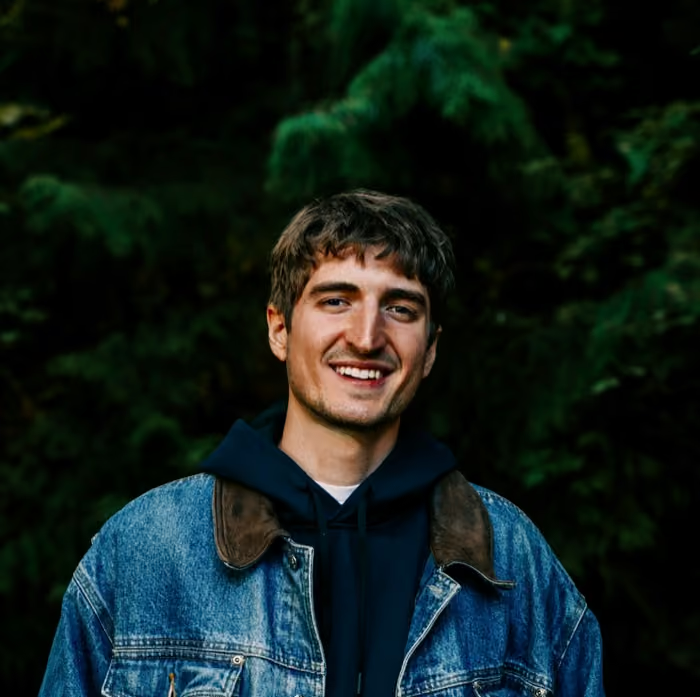
I'm Louis Belleau.
In Hong Kong, with every comfort and no sense of what it was for
Magic mushrooms at seventeen
More than a decade of yoga, Zen, Vipassana and now Dzogchen
One-to-one coaching, Psygaia, retreats and writing, from Vancouver
My parents were wealthy, I grew up in Hong Kong, and from an early age I had the kind of life most people work decades to afford. We travelled comfortably, stayed in beautiful hotels, ate great food. I still had to earn what I wanted, and nothing about my future was promised. It looked ideal from the outside, but in my teens I became depressed and saw no reason to want any of it. I started thinking about suicide. I drank and used drugs to feel anything at all.
The future I imagined was work, money, consumption, repeat. I had no purpose beyond myself and nothing calling to my soul, only a script I had not written. I knew I needed something bigger than myself to devote my life to.
Despair pushed me off the conventional path, and intuition told me where to start: self-discovery and healing with psychedelics, deepened insight through Buddhist meditation and the yogic path, academic study of philosophy and psychology, learning from Indigenous elders and wilderness rites of passage. And most importantly, daily practice.
I have worked hard to find my place in a world that once felt alienating, and to build a life around what matters to me. Today that life includes academic research, a psychedelic and ecological medicine nonprofit, one-to-one coaching and psychedelic guidance, retreats, website design, and writing. I make plenty of time for adventure and play too, usually on skis or a surfboard.
The life I have now answers a question I was already asking at fifteen: what is worth devoting a life to? I had been handed the script most of us inherit, in its most comfortable version, and it quickly stopped making sense. Having everything it promised showed me early that more comfort, money, and possessions could not answer the question. Most people meet the question later, often when a career, a relationship or a belief they built their life around stops meaning what it did.
Material abundance can give us freedom without telling us what to do with it. What we are actually looking for was never something money could buy.
They gave me speed to slow me down
I was diagnosed with ADHD as a child. The Ritalin started at ten and lasted five years. It sharpened my focus and dulled everything else. I finally had decent grades, but nothing else got better.
By fifteen I was thinking about ending my life every day. Not because I was mentally ill, but because I could not see what any of it was for. I felt trapped in a meaningless life, surrounded by a culture of material obsession and spiritual poverty.
The life on offer was a 9 to 5, debt, and endless consumerism. It seemed terrible to me. At seventeen, I took magic mushrooms alone in my room, reconnected to spirit, and wanted to live again.
Then I chased the mystical dragon. Bigger visions, more often. I integrated nothing. The dark night of the soul arrived on a high dose of LSD and took everything apart.
What put me back together wasn't more. It was less. Multiple ten-day silent meditation retreats. Daily practice. Breathwork intensives. Water fasts and solo vision quests. And later, ayahuasca ceremony.
The point of the spiritual path isn't self-transcendence. It's return. To the body, to other people, and to a living world.
The kinds of people I work with
There's no single profile. People arrive by different roads, and they have one thing in common: the story they were living by has run out.
You've succeeded at what you set out to do, and it's no longer enough
You built something or climbed the corporate ladder and made the money. The view isn't what you expected, and the feeling you were working toward never quite arrived.
You're good at work that's draining you
You've done it for years, and because you're good at it, the world keeps offering you more of the same. You've wanted something else for a long time, and you can no longer picture what it would be.
You no longer know what the next part of your life is for
For years you knew what you were working toward. Now each next goal feels arbitrary, and the drive that carried you this far has gone quiet.
You've done years of inner work and something still isn't changing
Retreats, daily sitting, plant medicine ceremonies, therapy. You've spent years and real money, you've got the tools and the knowledge, and it still hasn't changed you in the way you aspire to.
A psychedelic experience has changed the story you were living
Something you saw has become hard to fit back into ordinary life. You want to understand what happened without dismissing it or building your whole identity around it.
Your idea of a good life is colliding with the state of the world
You're thinking differently about consumption, climate, and what you're leaving behind. What once felt like success is starting to feel implicated, and you want responsibility that doesn't collapse into guilt.

Deep down, we hunger to meet our soul. All during the course of our lives we struggle to catch up with ourselves. We are so taken up, so busy and distracted, that we cannot dedicate enough time or recognition to the depths within us.John O'Donohue
How far does knowing yourself actually go?
This is my own view, based on over a decade of embodied practice and interdisciplinary study.
Most of us inherit an idea of what makes a good life long before we are old enough to question it. Work hard. Become successful. Find a partner. Build a life. Earn enough freedom to enjoy it.
There is nothing inherently wrong with any of that. But eventually some people discover that they have been very good at pursuing goals they never consciously chose.
When the old motivations stop working, the temptation is to buy something new or find another goal. A new career. A new car. A new relationship. A spiritual practice. Another version of yourself to become.
I know that pattern because I lived it. For a while I thought the answer was transcendence: go further, experience more, understand more.
It wasn't.
What I have come to believe is that a meaningful life requires knowing yourself as part of a larger whole, and in the end as not separate from it. That means knowing what you belong to, what deserves your devotion, and what kind of story your life, or soul, is actually expressing in relation to the whole.
Human beings have always used stories and myths to orient themselves toward questions that cannot be solved by productivity alone. Who am I? What am I responsible for? What is worth suffering for? What do I serve? How should I spend the life I have been given?
Sometimes the story organizing a life stops working. That can feel like something has gone wrong. It can also be the beginning of living more deliberately.
And the search eventually leads beyond the individual. Nothing alive exists by itself. A cell belongs to a body, a body to a community and habitat, a human life to relationships extending through culture, ancestry and the living world. Your health, the health of the people around you, and the health of the ground under your feet are one question rather than three.
Go far enough, and the line between you and the world stops holding. Meaning does not seem to be something we manufacture privately inside ourselves. It emerges through relationship and participation.
Different traditions have described this in their own ways. Buddhism speaks of dependent arising and no separate self, which Thich Nhat Hanh called interbeing. Advaita Vedanta identifies the deepest self with ultimate reality. Ibn Arabi explored the unity of being. Meister Eckhart said the eye with which I see God is the eye with which God sees me. Many Indigenous traditions begin from kinship with the living world. Ecology gives us another language for the same interdependence.
I don't think there is one universal answer to what makes a life meaningful. I think there is a practice of learning to listen more carefully: to your own life, to the people you love, to your body, to the places you inhabit, and to the questions that refuse to leave you alone.
Eventually the question changes.
Not only “Who am I?” But “What am I part of, and what is mine to do?”

In the beginner's mind there are many possibilities, but in the expert's there are few.Shunryu Suzuki
Four practices, thousands of years old
Tested by more lives than any modern method.
What is a life for, once getting more stops being the answer?
People have asked it for as long as they have written things down. Buddhism begins with dukkha, the dissatisfaction of clinging to what does not last, and asks what freedom from that pattern looks like. Ecclesiastes looks at wealth, work and reputation and calls them hevel: vapour, impossible to grasp, usually translated as vanity. Aristotle ruled out pleasure, wealth and status as the highest good and pointed to eudaimonia instead, a flourishing life shaped by character and wisdom. Lakota prayers close with mitákuye oyás'iŋ, all my relatives, a kinship reaching past people to animals, land and ancestors. The Dakota writer Ella Deloria put the aim of that way of life simply: to be a good relative.
These traditions diverge on much but share one suspicion: a meaningful life cannot be built out of getting more. Noticing that is one thing. Learning to live differently is another.
Inquiry, meditation and breathwork are ways of examining the mind, working with the body, and loosening patterns that once seemed unquestionable. Psychedelics are relational medicines. Approached with care, they widen the frame further, to how we understand ourselves and what we ultimately belong to. The way I teach all four draws on those traditions and on what psychology and neuroscience have added since.
Inquiry
Socratic · Buddhist · Vedantic
Examining the assumptions the thinking mind takes for granted. Meeting the intellect on its own ground and inviting it to see through itself.
Meditation
Buddhism · Zen, Vipassana, Dzogchen
Calm first, then insight. Attention steady enough to watch experience closely, until you see for yourself that it changes constantly, that grasping at it hurts, and that no one inside is running it.
Breathwork
Yogic pranayama · modern breathwork
Taking the work into the body. It regulates the nervous system and returns awareness to the intelligence the body already carries.
Psychedelics
Indigenous plant medicine · psychedelic research
Loosening the ego, opening to the whole. Rigorous preparation, supportive guidance, and lifelong integration. Training for those learning to do this themselves.
You come back to life
Stay with it long enough and you start to see things as they are, rather than as you make them. Perception is built moment by moment, and so is the self you took yourself to be. Everything is held together by everything else. The baseline moves and it stays moved: less reactivity, enduring meaning, a sense of connection to the living world, and more depending on how and what you practice.
The flatness lifts. Things move you again, the way they did before you got good at not being moved.
You may still have a five-year plan. Now it comes from your own convictions, and you can tell when you're off track.
You come back down into your body. Tension, tiredness, a gut feeling about a person: you notice them now, and you listen.
Trees become more than scenery. Waterfalls teach. The people closest to you get more than what is left at the end of the day.
You stop performing for others. The version of you built for their expectations gets quieter, and the one underneath gets a say.
A reason to be here that comes from your place in something much larger than the small, individuated self.

It is important to expect nothing, to take every experience, including the negative ones, as merely steps on the path, and to proceed.Ram Dass
Where this comes from
I went looking for this because I needed it, and the training came as a result.
- BA in Psychology, Philosophy and Comparative Religion, McGill University
- MA in Psychedelics and Consciousness Studies, University of Ottawa
- Over a decade of contemplative practice: Zen, Vipassana, and now Dzogchen
- 200-hour yoga teacher training
- Conscious connected breathwork training
- Training in psychedelic preparation, guidance and integration
- Taught meditation, yoga and breathwork in mental health and addiction-recovery settings
- One-to-one psychedelic guidance and integration
- Led retreats, wilderness experiences and men's groups
- Founder of Psygaia, a psychedelic and ecological medicine research nonprofit
- Co-founder of the Mindful Men's Guild

If you are unable to find the truth right where you are, where else do you expect to find it?Dōgen Zenji
In their own words
These are from single journeys, preparation sessions and retreats. They describe what it is like to sit down with me, which is where the longer work starts too.
As a busy COO of one of America's fastest growing companies, it's been so long since I've had the opportunity to unplug and take the special time needed to reconnect with myself, find healing and practice mindfulness. An incredible safe space, and a beautiful community of people seeking healing and growth.
Louis naturally breathes and embodies a presence of deep peace. The breathwork sessions we did together were life changing. A combination of crystal clear intuition and skillful guidance made me feel safe and held, allowing for a frozen part of me, stuck and hidden in time, to open and melt with great lightness and ease.
When I first met Louis, his openness and confident vulnerability drew me in. After doing breathwork with him, I saw that guiding others was his true calling. Louis's peaceful demeanor was calming and I felt a deep sense of safety. Our conversations have lightened my path, reducing shame and revealing a core value of compassion. His knowledge of Buddhism, yoga, and nature-based traditions has deepened my practice, teaching me gentleness towards myself.
The hour-long consultation with Louis before my journey left me as prepared as possible to take the leap, and as a result I had the most meaningful psychedelic experience of my life. Among the most useful parts was learning a new breathing practice that allowed me to stay grounded throughout. That practice has become a pillar of my daily life.
I came hoping to find certain answers. Instead, I was delivered something better. I did not get what I wanted out of it. I got what my body and soul needed.
I felt connected, seen, and safe in a way my soul has been yearning for a very, very long time. I am so grateful.

Reciprocity is a matter of keeping the gift in motion through self-perpetuating cycles of giving and receiving.Robin Wall Kimmerer
The deepest work happens over time
This work takes months, not one good conversation. In that time I come to know your history, your patterns, and the particular shape of what you're carrying.
We map what is going on, you build a practice you keep, and we test one or two changes in your ordinary week. At the end we look at what moved.
Two seasons. In the first, we map what is going on and you build a practice. In the second, the changes you try have time to settle into your weeks, and we adjust them as we go. We look back at three months and again at the end.
For people who want to keep someone close after the deeper work. I know your history, so we start where we left off. A call when something comes up, a message in between, and someone alongside you as the healing, growth and self-discovery go on.
Between sessions
You can reach me on WhatsApp between sessions, for whatever comes up. Expect a reply within two or three days.
Other ways to work with me
I co-founded the Mindful Men's Guild, a small monthly group for men: meditation, breathwork, honest conversation, and retreats around the world, some of them with medicine and some without. Some people begin in a group and continue individually. Others meet me first. Either path works.

The more you know, the less you need.Yvon Chouinard
What to expect, step by step
Discovery call · 30 minutes
A conversation to meet each other and see whether this is a fit. No pitch, no obligation.
Mapping the crossroads
The early sessions are for working out what is actually going on: what raised the question, what you want to keep, and what has stopped working. We separate the sources rather than assuming one explanation.
Practice between sessions
Meditation, inquiry, and where it fits, embodied practice. The point is to notice your own patterns during the week, not only in the room.
Experiment and review
We pick something manageable to try in ordinary life, then look at what it showed. The direction changes as you learn, which is expected.

Not more. Less.
If something here landed, that's enough to begin. The first conversation commits you to nothing.
See if we're a fit30 minutes · No obligation
Common questions
If something here isn't answered, ask on the call. All questions are welcome.
Therapy usually works on the past, and a therapist can diagnose and treat. I do neither. This is coaching and guidance: inquiry, practice, and attention to the life you are actually living. If you are in acute crisis, please get clinical care first. Plenty of people see a therapist and me at the same time.
By video, wherever you are. I'm in Vancouver, so we can meet in person if you're local. Most people meet twice a month, with practice in between.
No. Some people I work with change their work. Some change how much room it takes up. Some stay exactly where they are and relate to it differently. I have no stake in which one you choose. I will ask questions that make the arrangement you are living in visible. That can be uncomfortable whatever you decide.
I work with people who pray and people who think all of that is nonsense. The practices are practices: you do them and find out what happens. Nothing here asks you to sign up to a metaphysics, including mine.
No. It is never a requirement and I won't raise it unless you do. The core work is inquiry, meditation and breathwork, and it stands on its own. Most of what changes for people changes there.
Preparation, which is most of it. Then sitting with you through it, in person: privately in Canada, or travelling together to Central or South America. Then integration, which is where the change consolidates or doesn't. I also train people to do this work on their own. I don't supply, source, or administer anything.
None at all. Practices are introduced from wherever you are. Prior experience sometimes means there are patterns to undo, since what I teach is often different from what people have met elsewhere.
Stay connected via Substack
Essays on psychedelics, meditation, consciousness, wellbeing, and grounded spirituality. Retreats and special offerings are announced here too.